

Chelsea broke the British transfer record when they paid Aston Villa £117 million for Morgan Rogers, a fee that also made the 23-year-old forward the club’s most expensive signing of all time. The deal, confirmed on the 21st of July 2026, was the headline arrival of Xabi Alonso’s first summer in charge and brought to Stamford Bridge a player who had needed barely two and a half years in the Premier League to go from a squad member without a single senior appearance at Manchester City to a PFA Young Player of the Year and a Europa League winner with Villa.
Who is Morgan Rogers?
Morgan Elliot Rogers was born in Halesowen, in the West Midlands, on the 26th of July 2002. Right-footed and six foot two, he is a versatile attacker, equally comfortable drifting off either flank, playing centrally as a number ten, or, when required, dropping into a deeper midfield role. By the time his move to Chelsea was completed, he had been directly involved in 40 Premier League goals, either scoring or assisting, in 85 appearances for Aston Villa. Rogers joined West Bromwich Albion’s academy at the age of nine after catching the eye of scouts in his hometown.
Manchester City signed him in 2019, but he never made a first-team appearance at the Etihad Stadium, spending the following years out on loan in the lower divisions of English football at Lincoln City, Bournemouth and Blackpool, as City tried to find him regular senior football elsewhere. The move that finally gave Rogers a proper run in the first team came in the July of 2023, when Middlesbrough signed him from the Abu Dhabi-owned club on a permanent four-year deal for a reported fee of around £1.5 million.
Breakthrough Switch to Aston Villa
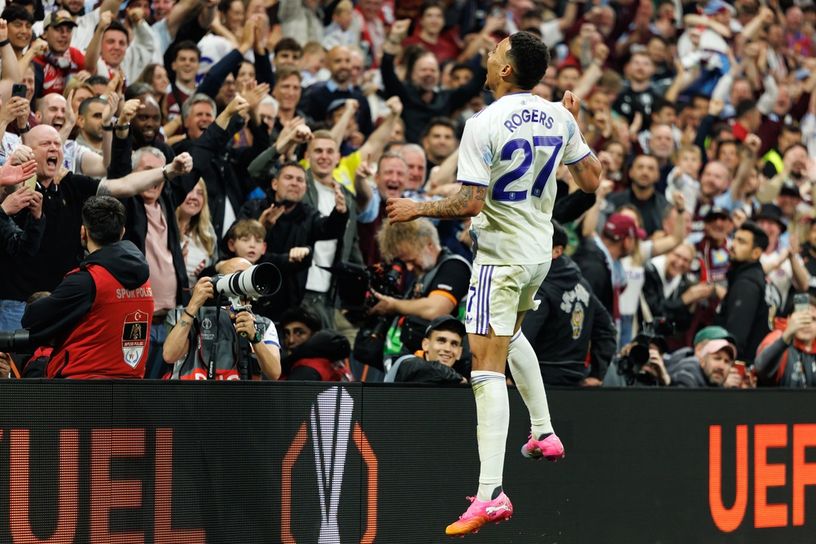
In his single season at the Riverside, he found the net seven times and set up nine more goals in 33 Championship appearances, which was form that caught the attention of manager Michael Carrick and, before long, of Aston Villa. Villa moved for Rogers on transfer deadline day in the January of 2024, agreeing an initial £8 million fee with Middlesbrough that carried add-ons capable of taking the total to £15 million. He settled quickly into Unai Emery’s side and by that November, only months into his Premier League career, he had signed a new contract at Villa Park running until 2030.
The following season brought his breakthrough, getting 16 assists and 14 goals in all competitions, which was a haul that included a hat-trick away at Celtic in the Champions League and left him joint-fourth for Premier League assists that term. That form earned Rogers the PFA Young Player of the Year award in the August of 2025, chosen by his fellow professionals ahead of a shortlist that included Liam Delap and Dean Huijsen. His following season was even bigger, thanks to Villa reaching the final of the Europa League in Istanbul.
There, a Rogers assist teed up Youri Tielemans’ opening goal and Emiliano Buendía doubled the lead before the break, then Rogers himself turned in a Buendía cross early in the second-half to complete a 3-0 win over SC Freiburg on the 20th of May 2026. It was Villa’s first major trophy since the 1996 League Cup and their first European honour since the 1982 European Cup. UEFA’s Technical Observer Group later named Rogers the competition’s Player of the Season, with three goals and five assists from 15 appearances and more minutes and distance covered than any other Villa player across the campaign.
The Europa League triumph came alongside a top-four finish in the Premier League, securing Champions League football for the following season. Rogers made his senior England debut as a substitute in a 3-0 UEFA Nations League win over Greece on the 14th of November 2024 and scored his first international goal in a friendly against Wales on the ninth of October the following year. Thomas Tuchel picked him for England’s FIFA World Cup squad in the summer of 2026 and Rogers set up Anthony Gordon’s opener as the Three Lions reached the semi-final.
The Move to Chelsea
Arsenal had been strongly linked with Rogers for much of the summer and were seen as his most likely destination, but they were unwilling to match the offer that Chelsea had made for him. The £117 million fee beat the British record of £116 million that Manchester City had paid Nottingham Forest for Elliot Anderson earlier the same window and it also made Rogers more expensive than Moisés Caicedo, whose £115 million move from Brighton in 2023 had previously stood as Chelsea’s record signing.
Rogers signed a seven-year contract running until 2033 and was given the number 17 shirt, previously worn at Stamford Bridge by Eden Hazard, Pedro and Mateo Kovačić. Rogers called Chelsea ‘the biggest club in London’ on completing the move, pointing to conversations with Xabi Alonso about how the new head coach wanted his team to play as a significant factor behind his decision. He also spoke of his excitement at linking up again with Cole Palmer, a friend since their days together in England’s youth teams and at Manchester City’s academy.
The switch also meant giving up Champions League football with Aston Villa in order to join a Chelsea side with no European competition to look forward to in 2026-2027, with the player hoping that the combination of Alonso’s arrival and the money continuously being spent by Chelsea will be enough to see them challenging for major honours as well as returning to Europe’s elite competition next season. Whether that is a gamble that pays off or not remains to be seen, but certainly there is enough evidence to suggest that Chelsea fans can get excited.
Rogers built his reputation on his physical strength in the final third, his direct running in behind opposition defences and a knack for scoring from distance, which are qualities that both Middlesbrough and Aston Villa supporters came to rely on. Predominantly right-footed, he has been used productively as a wide forward on both flanks, as well as a central number ten and, during England’s run to the World Cup semi-final, in a deeper number eight role. That versatility, backed up by genuine goal and assist numbers rather than reputation alone, is what persuaded Chelsea to pull the trigger.