
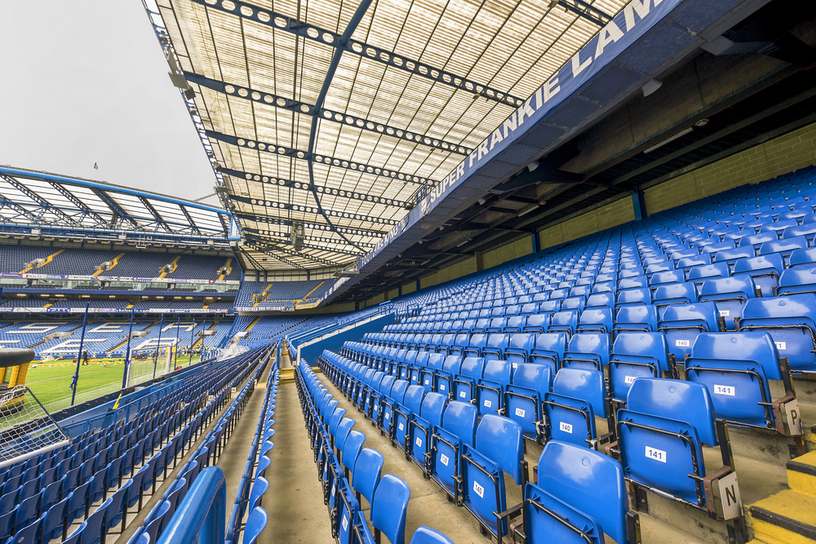
Stamford Bridge holds 40,341 people, which makes it one of the larger grounds in England but leaves it some way behind the biggest in the Premier League. For a club of Chelsea’s size and spending, that figure has become a talking point in itself and it is the single biggest reason that the question of what to do with the stadium keeps coming back around. The number has moved about a fair bit over the years, though, and the ground was once built to hold more than twice as many people as it does today.
A Ground Built for the Masses
When the stadium was laid out in 1877 and then handed to the newly formed Chelsea in 1905, it was built on a scale that is hard to imagine now. The original design, drawn up by the noted stadium architect Archibald Leitch, was meant to hold something close to 100,000 people, with vast open banks of terracing wrapped around a running track. Spectators were a long way from the pitch by modern standards, but you could fit an enormous number of them inside, which was important for a burgeoning football club looking to raise money from ticket sales.
The high-water mark came on the 12th of October 1935, when 82,905 people packed in to watch Chelsea play Arsenal. That remains the record attendance at Stamford Bridge and, given the fact that the ground now holds less than half that amount, it is a record that will never be beaten in its current form. Crowds in the tens of thousands were routine in that era, helped by terracing that would be unthinkable under today’s safety rules. If Chelsea choose to stay and redevelop the ground, then it might increase, but will it even really be the same stadium?
Why the Numbers Came Down

The thing that reshaped Stamford Bridge, like almost every major English ground, was the Taylor Report. Published after the Hillsborough disaster of 1989, it required the country’s top clubs to move to all-seater stadiums, which wiped out the standing terraces that had let so many people through the gates at a stroke. Seats take up far more room than standing supporters, so converting the ground meant that the headline capacity fell sharply even as the stadium itself was rebuilt and improved.
Rebuilding Stand by Stand
The modern ground was put together in stages throughout the 1990s and into the early 2000s, one stand at a time. The old semicircular North terrace went first, replaced by a two-tier home stand that opened in the November of 1994 and was renamed the Matthew Harding Stand two years later, named in honour of the Chelsea vice-chairman who died in a helicopter crash. The famous Shed End terrace was next, rebuilt as a two-tier stand with a hotel and other facilities behind it and finished in 1997.
The last, and largest, piece was the West Stand, which opened in 2001, though a delay over its safety certificate meant that the upper tier was not fully in use until the 2001-2002 season. Once it was, the four-stand, all-seater ground that supporters know today was essentially complete and the capacity settled into the low forties of thousands, where it has stayed ever since.
Where the Capacity Sits Today
| Club | Stadium | Capacity |
|---|---|---|
| Manchester United | Old Trafford | 74,244 |
| Tottenham | Tottenham Hotspur Stadium | 62,850 |
| West Ham | London Stadium | 62,500 |
| Liverpool | Anfield | 61,276 |
| Arsenal | Emirates Stadium | 60,704 |
| Manchester City | City of Manchester Stadium | 52,900 |
| Everton | Hill Dickinson Stadium | 52,769 |
| Newcastle United | St James’ Park | 52,264 |
| Sunderland | Stadium of Light | 48,095 |
| Aston Villa | Villa Park | 43,205 |
| Chelsea | Stamford Bridge | 40,341 |
The current figure of 40,341 has nudged around slightly in recent seasons as rail seating has gone into the Shed End and the Matthew Harding lower tier, but the headline number has stayed broadly the same. It is enough to make Stamford Bridge one of the dozen or so biggest grounds in the country, yet it is comfortably below Old Trafford, the Emirates, the Tottenham Hotspur Stadium and Anfield, all of which their rivals have expanded or rebuilt on a bigger scale.
That gap in capacity is the central piece of the whole debate about the stadium’s future. The ground’s tight, hemmed-in site makes expanding it far harder than at clubs with room to build, which is why the club has spent years weighing up whether to enlarge Stamford Bridge or move elsewhere. That long-running saga is tracked separately on the Chelsea New Stadium Developments page, whilst the layout of the current seating is covered on the seating plan page.