
Reece James has spent twenty years at Chelsea, joining the club’s development centre as a six-year-old and going on to captain the men’s first team, when, in the March of 2026, with more than 200 appearances and five major trophies behind him, he signed a new six-year contract that kept him at Stamford Bridge until 2032. It was a deal that the club moved to secure two years before his previous terms were due to run out. Although James is unquestionably a talented footballer and an excellent leader, his is a career that has been plagued by injury.
Who is Reece James?
Reece Lewis James was born on the eighth of December 1999 in Redbridge, London. He began playing football at Kew Park Rangers and Epsom Eagles before Chelsea signed him when he was six, save for a brief week on the books at Fulham a year later. His father, Nigel, worked as an elite coach, and his younger sister, Lauren, followed him into Chelsea’s Academy and on to full England honours. In fact, the pair are recognised by England Football as the first brother and sister to be capped by the senior men’s and women’s teams in the modern era.
As a boy at Cobham, James played as a forward and idolised Didier Drogba, before he was shifted first into midfield and then to right-back, a position he found difficult to adjust to initially. He made his Under-18s debut as a schoolboy in the 2015-2016 season and was a key figure the following year, as Chelsea’s youth side completed a treble. He signed his first professional contract in the March of 2017 and, the following season, was named Academy Player of the Season and captained the side that won the FA Youth Cup.
A loan spell at Wigan Athletic in the Championship in 2018-2019 proved decisive. He picked up both the club’s Player of the Season and Players’ Player of the Season awards at Wigan and Frank Lampard brought him straight into his first-team plans once the loan ended. James scored on his Chelsea debut in a League Cup win over Grimsby Town, added a goal against Ajax in the Champions League group stage and made 37 appearances in his first season back at Stamford Bridge. His second season then brought more rapid progress for the talented youngster.
James & Injuries Issues
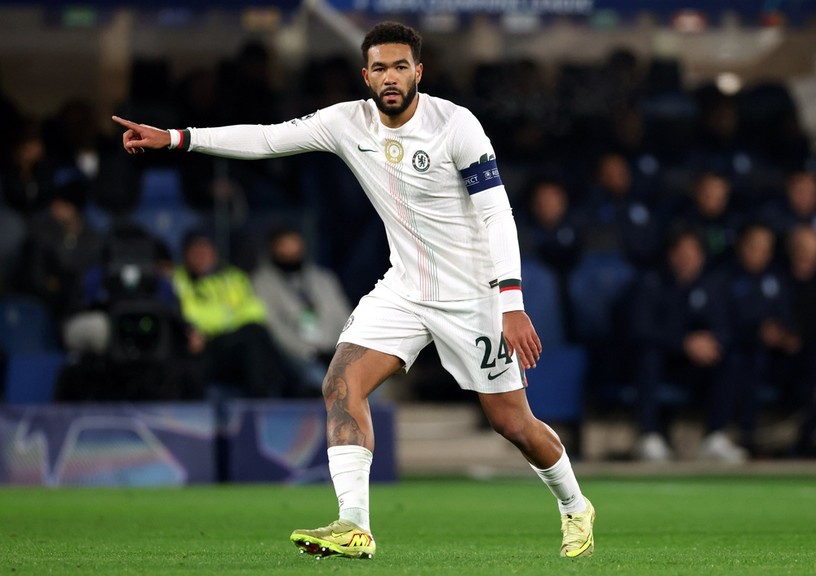
James soon became a first-team regular, won his first England caps, made 47 appearances and was in the starting XI as Chelsea beat Manchester City in Porto to win the 2021 Champions League final. The following campaign, he lifted the UEFA Super Cup and the FIFA Club World Cup and scored six goals in all competitions, though a hamstring injury picked up against Brighton & Hove Albion that December was the first of several muscular problems that kept recurring over the next three years, each one costing him several weeks on the sidelines at a time.
A knee injury sustained against Milan in the October of 2022 ruled him out for two months and cost him a place at that winter’s World Cup in Qatar. Further knee trouble followed in December and a hamstring issue ended his 2022-2023 season in the April. Mauricio Pochettino handed James the club captaincy ahead of the 2023-2024 season, but his first year with the armband was disrupted by injuries once again. This time, an early-season hamstring injury was followed in the December of 2023 by a recurrence serious enough to require surgery.
He did not return to first-team action until the May of 2024, coming off the bench to set up the winning goal against Nottingham Forest. A further hamstring problem delayed the start of his 2024-2025 season, yet James went on to lead Chelsea to their first trophy of his captaincy, coming on as a half-time substitute as the Blues beat Real Betis 4-1 in Wroclaw to win the UEFA Conference League on the 28th of May 2025. Six weeks later, under Enzo Maresca, he captained Chelsea to the FIFA Club World Cup, beating Paris Saint-Germain 3-0 in the final.
Getting More England Caps
The 2025-2026 season was, by James’s recent standards, a settled one. He made 44 appearances in all competitions and started 33 of them, his heaviest workload since the 2020-2021 campaign, before Chelsea moved in the March of 2026 to tie him to a new six-year contract. His Chelsea ledger by that point stood at upwards of 200 appearances, five major trophies won and more than fifty games played as the club captain. It was enough to catch the eye of the reasonably new England manager, who had previously managed him at Chelsea.
James was named in Thomas Tuchel’s England squad for the 2026 World Cup and started the group opener, a 4-2 win over Croatia. A hamstring injury picked up during the group stage ruled him out for the remainder of the tournament, with Djed Spence deputising at right-back as England went on without him. He returned to Chelsea for pre-season under a third head coach in seven months, thanks to Xabi Alonso’s appointment on the first of July 2026, replacing Liam Rosenior, who had himself only been appointed on the sixth of January, days after Maresca left the club.
James’s Playing Style
James is a right-footed full-back who still plays with the instincts of the forward he was as a boy. Frank Lampard, who handed him his Chelsea debut, called him a natural crosser of the ball and his whipped, early deliveries from the inside-right channel are still what most opposition defenders fear. He also strikes a ball cleanly from distance and takes Chelsea’s free-kicks and corners. He reads the game well enough to play as a conventional right-back or push on as a wing-back and his physical strength holds up in aerial and one-on-one duels.
It is that mix of end product and defensive reliability, on top of the armband he has carried since 2023, that has made him one of the first names on Chelsea’s team sheet whenever fitness allows. Of course, it is the latter sentence that has long been the issue as far as James is concerned, with no one, including the player himself, able to depend upon his fitness for long enough to mean that his appearances on a football pitch can be seen as anything other than a bonus. In some ways, that is why many were surprised when Chelsea chose to extend his contract.